The Experience Inflation Index: 1 in 4 "Entry-Level" Jobs Requires Experience

Table of content
- —1. One in four "entry level" jobs requires experience
- —2. Legal and Finance inflate the most
- —3. Which employers post the most inflated "entry" roles?
- —4. Flexible entry jobs demand more experience
- —5. The US sets the lowest bar — India the highest
- —6. Small companies inflate the most
- —7. The salary test: these are mid level jobs in disguise
- —Conclusion
- —Methodology and limitations
Everyone has a story about the entry-level job that wanted three years of experience. Recent grads treat it as a fact of life; recruiters insist it's overblown. But when I went looking for actual numbers, I mostly found anecdotes, screenshots, and vibes.
So I measured it. I pulled 30,534 active job postings from the Hirebase index — which crawls 300,000+ company career pages and 80+ ATS platforms directly, so these are live jobs straight from the source, not scraped from an aggregator. I filtered down to the 11,920 postings with entry-level titles (Junior, Associate, Graduate, Trainee), then checked the minimum years of experience each one actually demands in the job description.
The short version: the meme is real, but smaller than the internet thinks — and the places where it shows up are not the ones I expected.
Key findings:
- 27.3% of "entry-level" jobs require at least a year of experience
- Legal and Finance inflate the most — Retail barely at all
- The employers posting the most inflated "entry" roles
- Hybrid and remote entry jobs demand 2× the experience of in-person ones
- The US actually sets the lowest bar of any major market
- Small companies inflate more than enterprises — not less
- The salary data proves these are mid-level jobs in disguise
- My methodology
1. One in four "entry level" jobs requires experience
First, the baseline. Of 11,920 entry-titled postings, 72.7% require zero years of experience — the label is honest most of the time. But 27.3% require at least one year, and 6.5% (775 postings) require three or more. A hardcore 2.9% want five-plus years for a job titled "Junior" or "Associate."
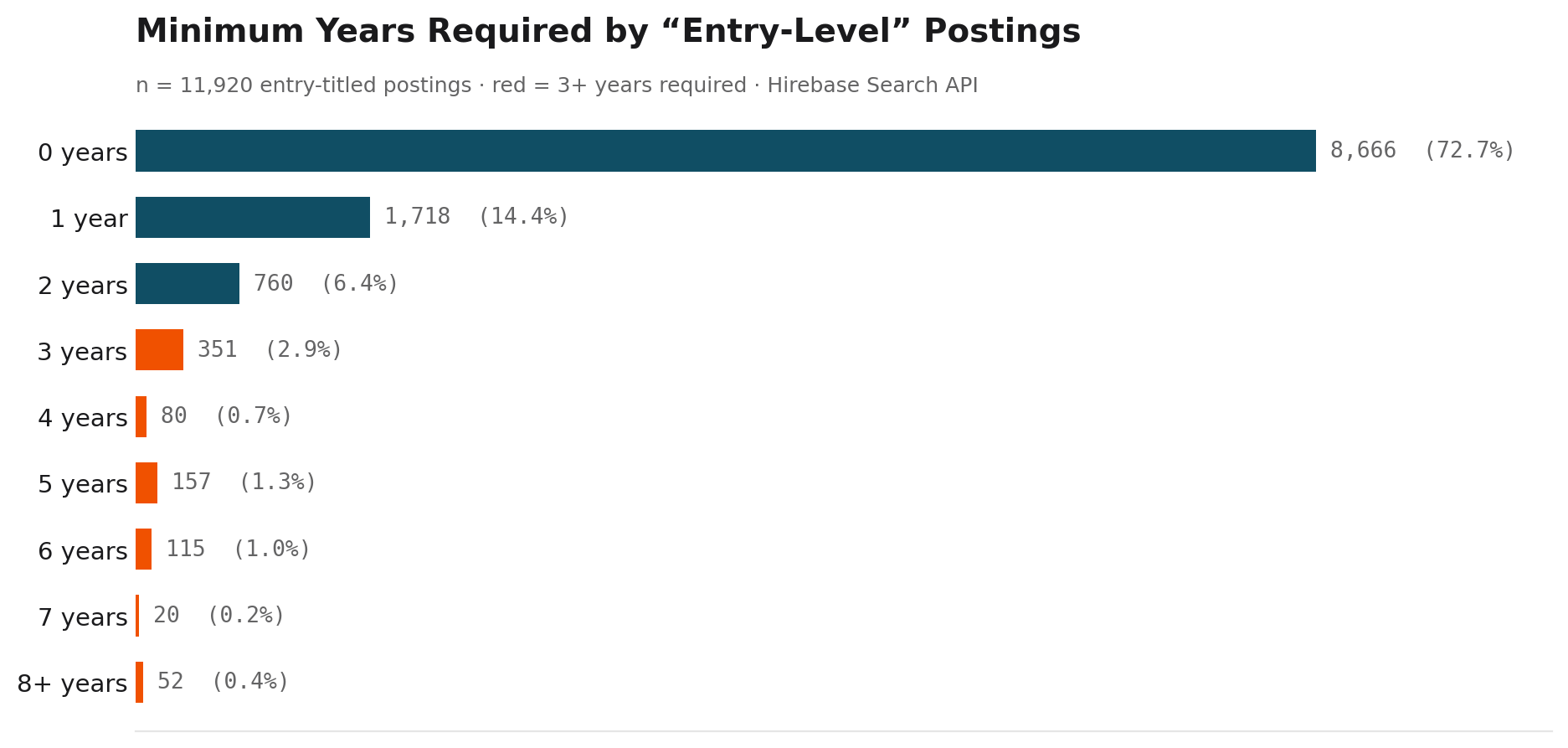
That 6.5% is our benchmark for the rest of this analysis. It sounds small until you remember what it means: roughly one entry-titled posting in fifteen is describing a job that a recent graduate cannot get. Every segment below is measured against it — which industries, employers, countries, and company types sit above or below that line.
The average minimum requirement across all entry-titled jobs works out to 0.57 years. "Entry-level" still mostly means entry-level. But the exceptions cluster in very specific places, and if you're job hunting in one of those places, your experience of the market will look nothing like the average.
Entry-level means you enter. It shouldn't mean you re-enter.
2. Legal and Finance inflate the most
I expected experience inflation to be spread thinly across the market. It isn't. It's concentrated — heavily — in a handful of industries:
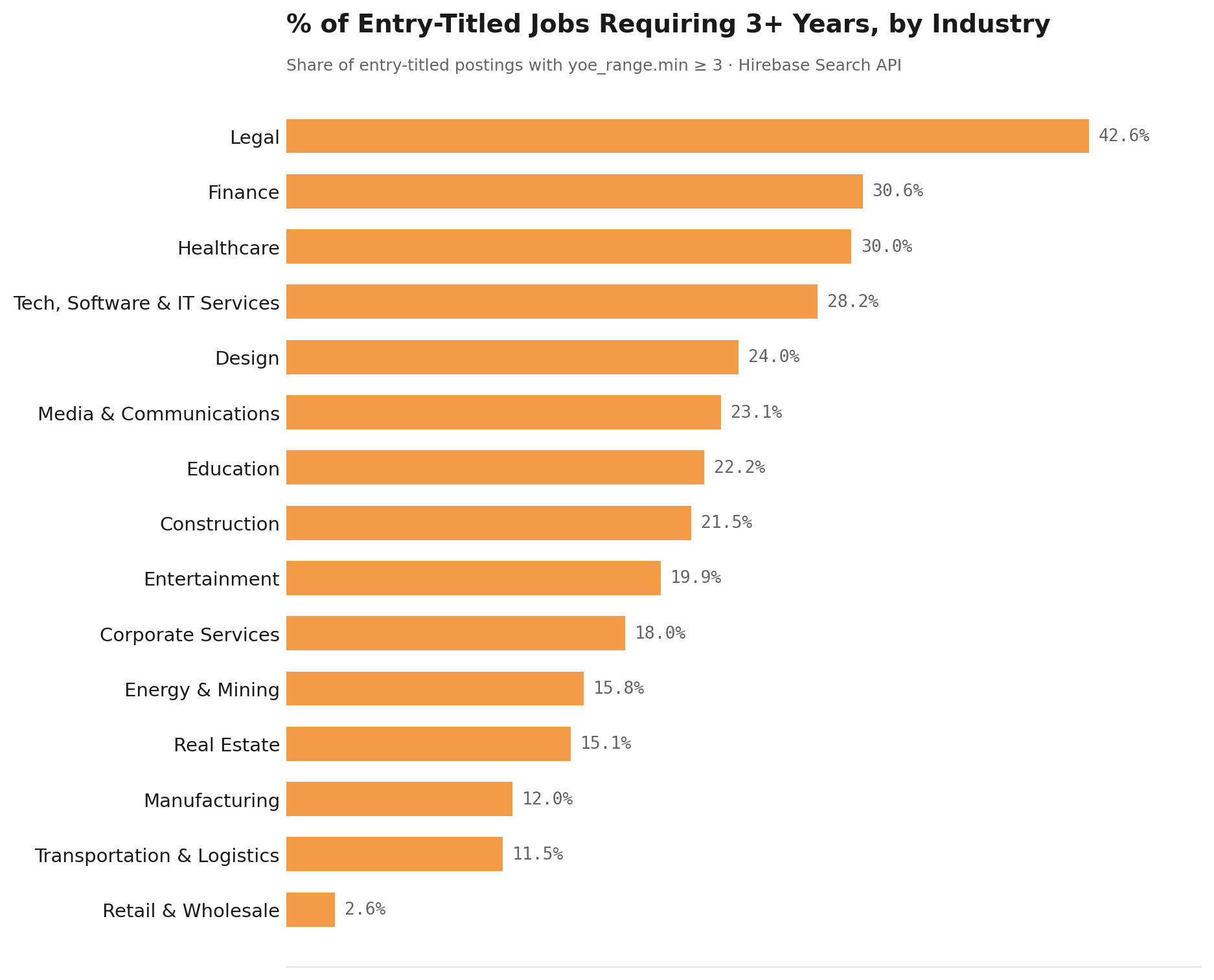
Legal sits at 42.6% — more than six times the 6.5% benchmark. Finance (30.6%), Healthcare (30.0%), and Tech (28.2%) all run four times the benchmark or higher. At the other end, Retail & Wholesale is at 2.6%: when a store posts a "Sales Associate" role, it genuinely means anyone can apply.
Part of what's happening here is vocabulary, not just gatekeeping. In law and professional services, "Associate" describes a multi-year career stage — an Associate Attorney has passed the bar and often practiced for years. In retail, "Associate" means any floor employee. Both get read as "starting position" by candidates, and only one of them is. I'd argue this makes the problem worse, not better: the industries where the entry label is least trustworthy are exactly the ones new grads are most desperate to break into.
3. Which employers post the most inflated "entry" roles?
Counting inflated entry-titled postings (3+ years required) per employer in my sample, legal recruiters and professional-services firms dominate — consistent with the industry pattern:
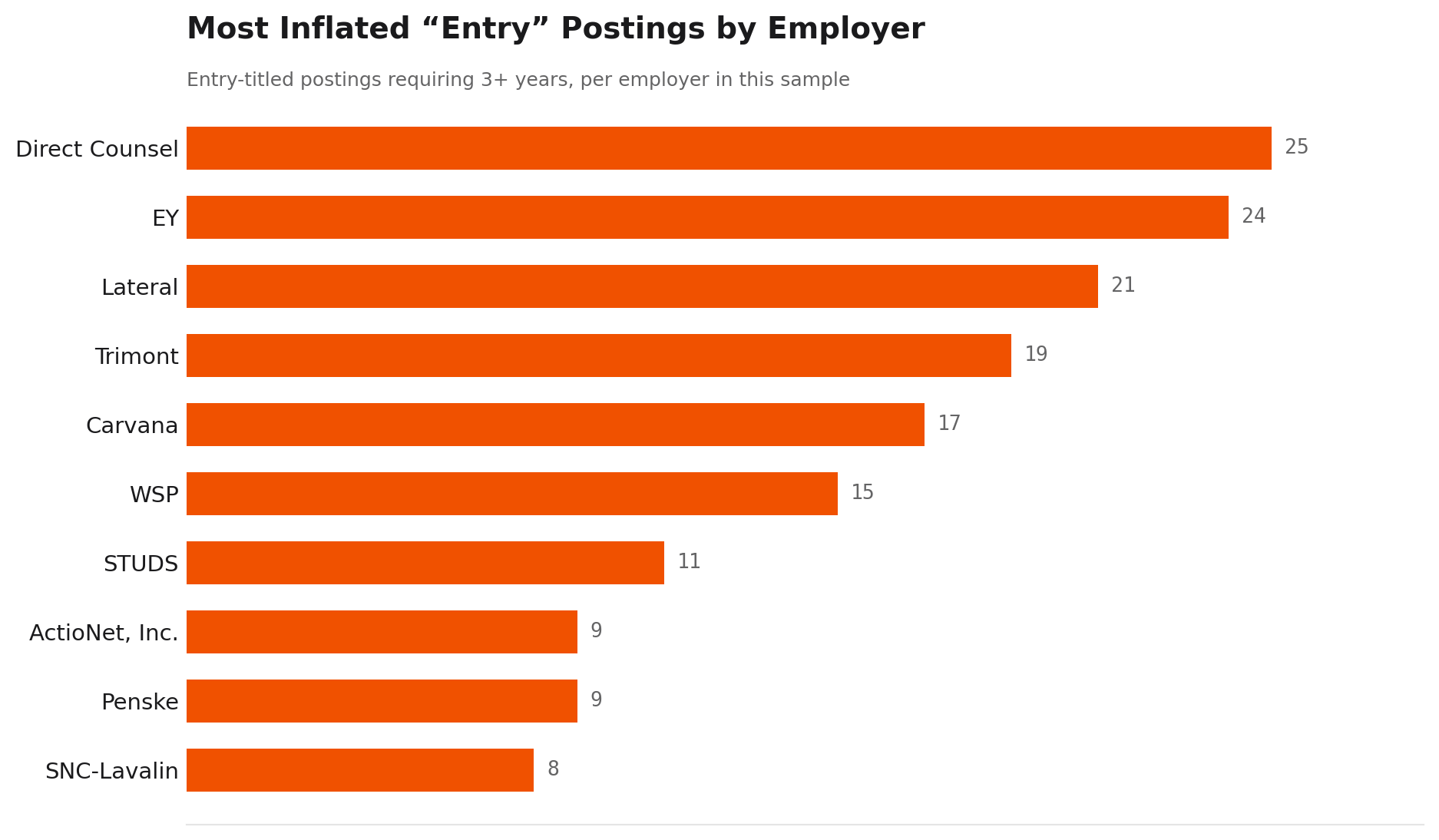
One caveat I want to make loudly: a high count here reflects hiring volume and industry title conventions as much as anything else. A legal staffing firm posting dozens of "Associate Attorney" roles that require prior practice will top this list even though that phrasing is completely standard in law. This is a measure of label-versus-requirement mismatch — how often a title reads as entry while the requirements don't — not an accusation of bad faith.
4. Flexible entry jobs demand more experience
This was the finding that surprised me most. Split entry-titled jobs by work arrangement, and the inflation rates aren't close:
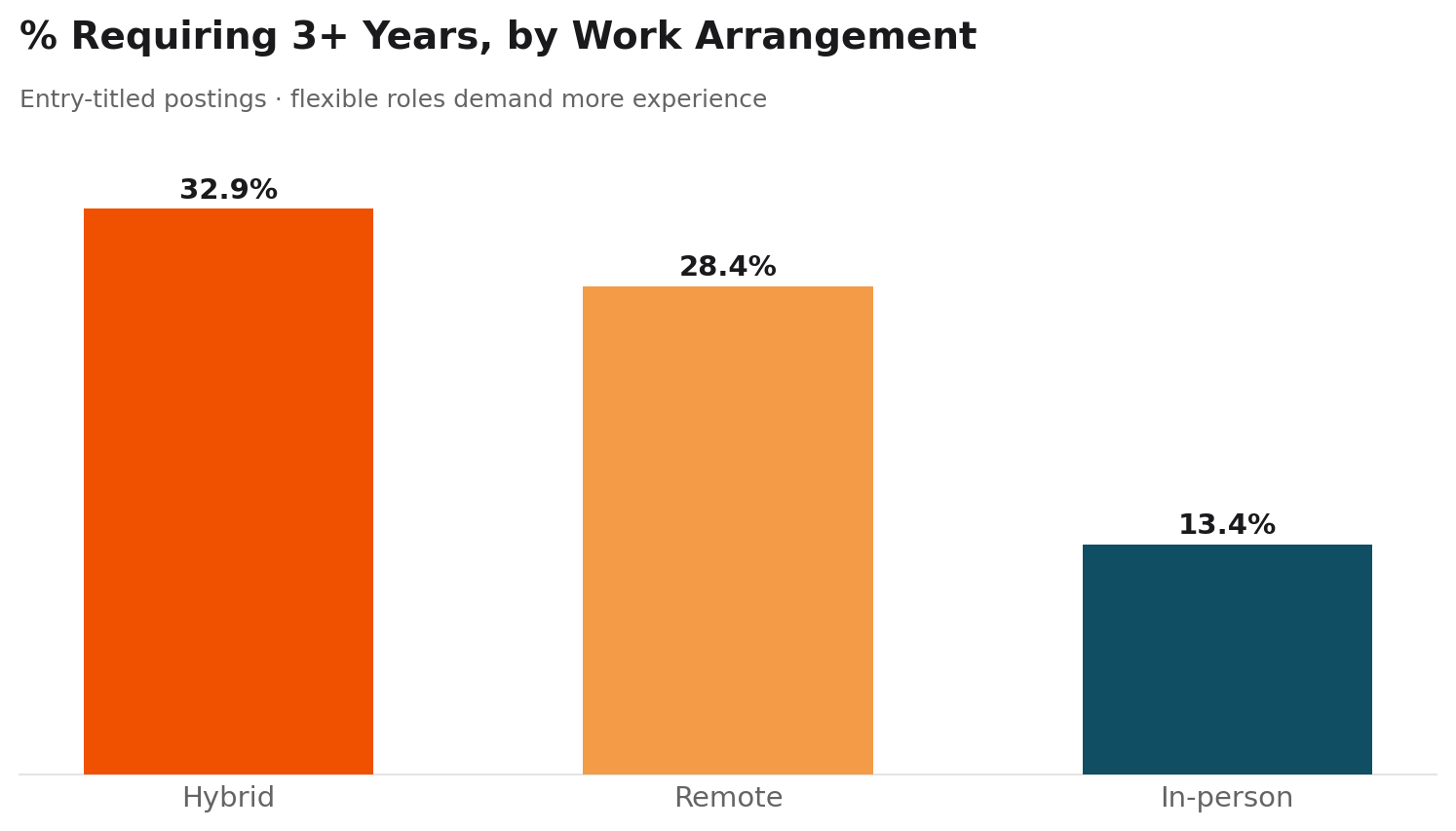
Hybrid (32.9%) and remote (28.4%) entry roles are more than twice as likely to require 3+ years as in-person ones (13.4%). The story the data suggests: employers will take a true beginner when they can train and supervise face to face. When they can't watch you work, they want you to arrive already knowing how.
For new grads this is a genuinely unfair trade — the flexible jobs everyone wants are the ones least available to people actually at the entry level. Flexibility, it turns out, is treated as something you earn with experience, even inside "entry-level" postings.
5. The US sets the lowest bar — India the highest
Among the five countries with the largest samples in my data, the US comes out looking like the most honest labeler, which is not the story I expected to write:
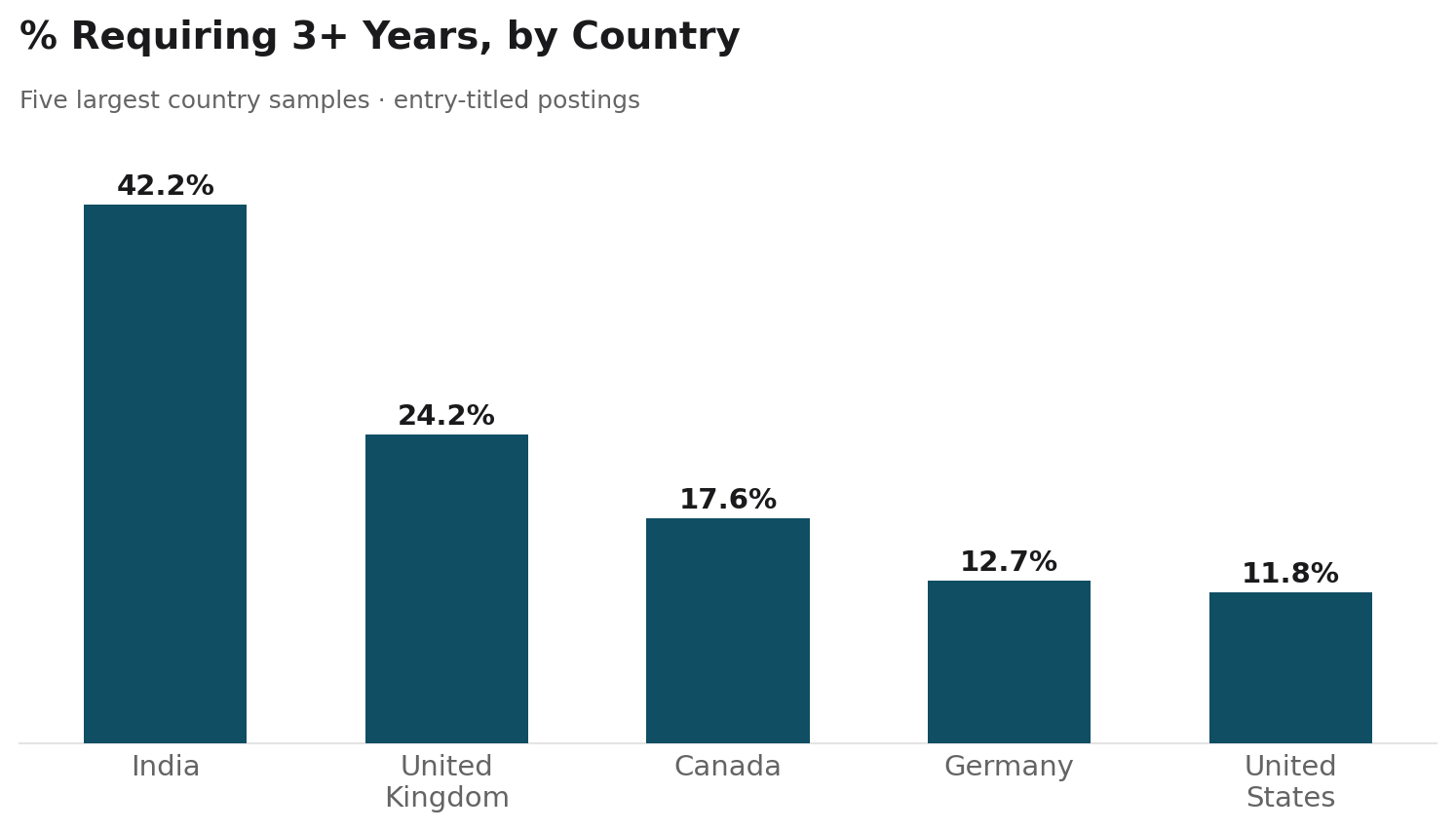
42.2% of India's entry-titled postings require 3+ years — more than triple the US rate of 11.8%. The UK (24.2%) and Canada (17.6%) sit in between. If you've seen the "entry-level, 4 years required" complaint framed as a uniquely American disease, the data says otherwise: the American entry label is the most reliable of any major market here.
6. Small companies inflate the most
Here's another finding that runs opposite to intuition. You'd think big enterprises — bureaucratic, checklist-driven — would pile requirements onto entry roles. The data says the reverse:
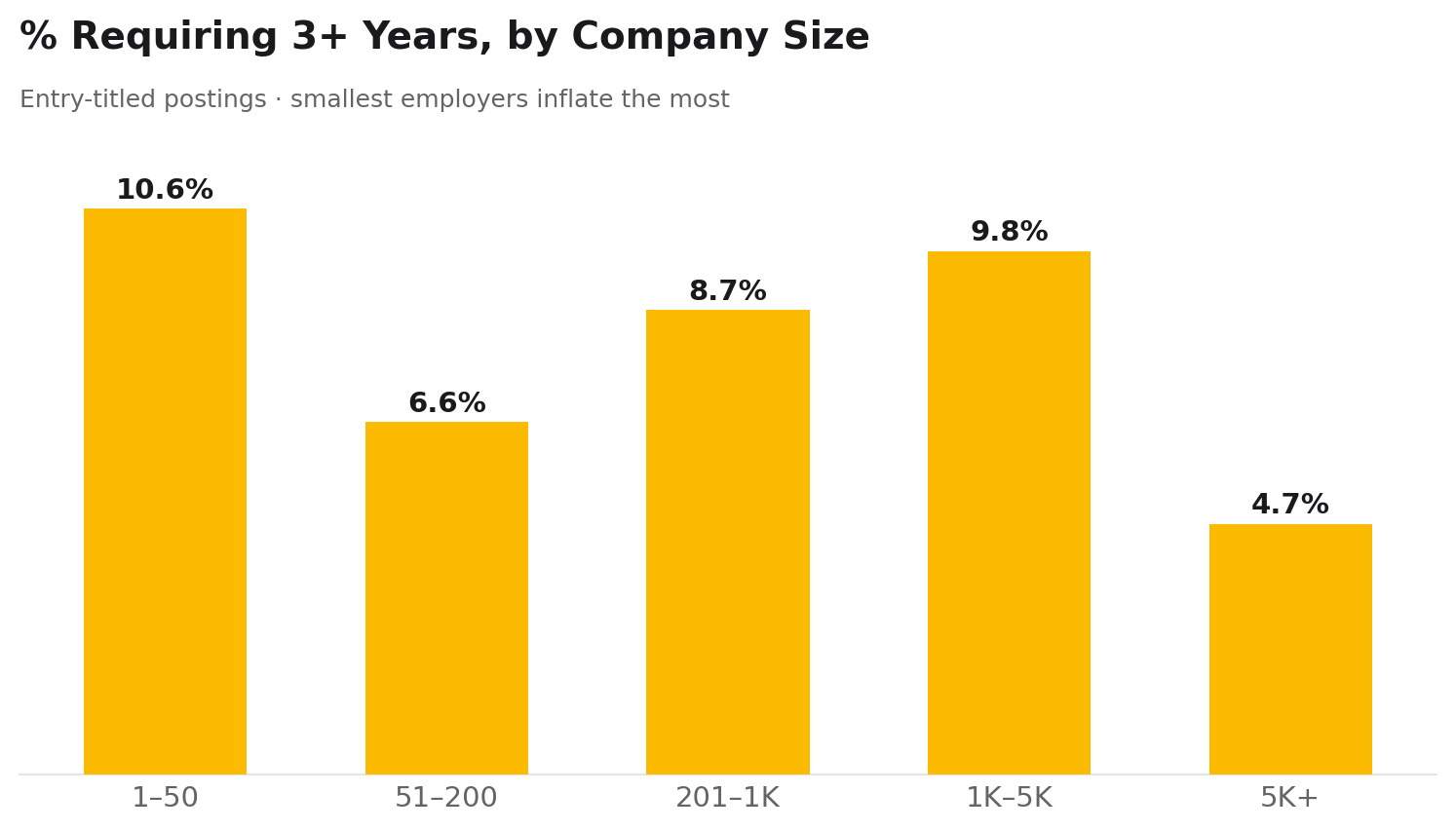
The smallest employers (1–50 people) inflate the most, at 10.6% — enterprises (5K+) the least, at 4.7%. My best explanation: small teams can't afford to train. Their "junior" hire has to be productive on day one, so the title says junior but the requirements say otherwise. Enterprises, meanwhile, are the ones still running structured graduate programs — the machinery that keeps entry genuinely entry.
If you're a new grad optimizing for actually getting hired at the level your resume supports, this argues for aiming bigger, not smaller.
7. The salary test: these are mid level jobs in disguise
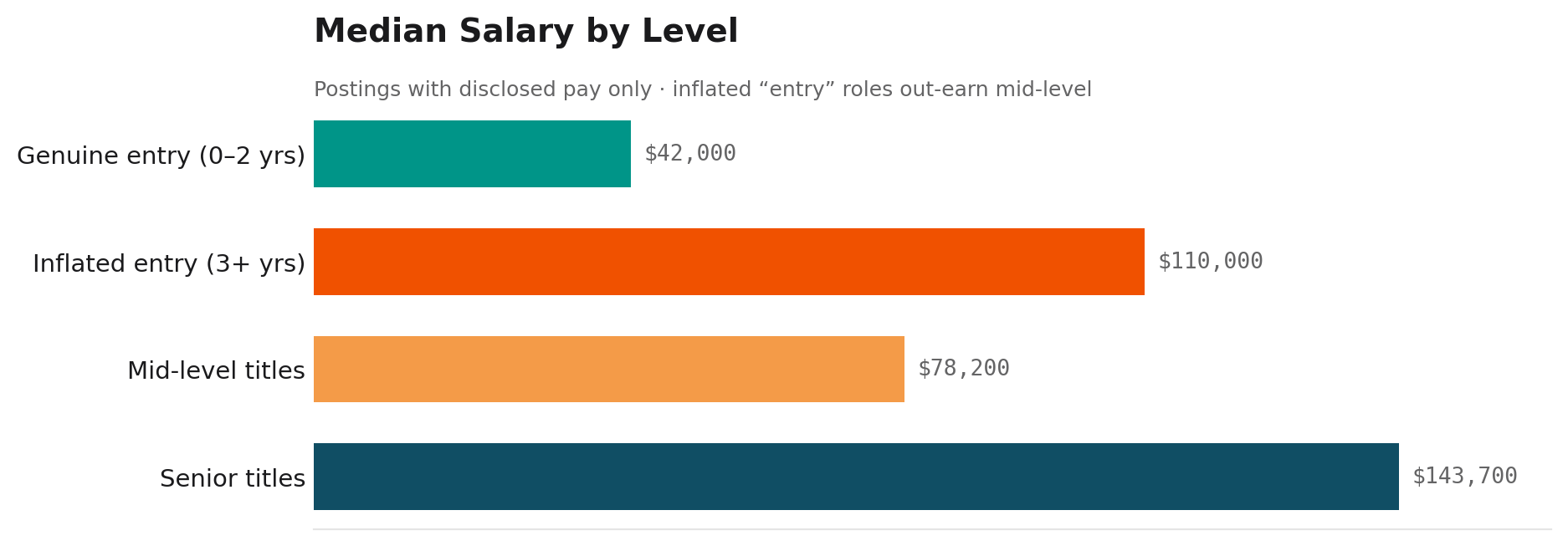
If inflated "entry" jobs are really mid-level jobs wearing the wrong label, the pay data should show it. It does — emphatically. Among postings that disclose pay:
| Level | Median salary | Postings with pay data |
|---|---|---|
| Genuine entry (0–2 yrs) | $42,000 | 3,068 |
| Inflated entry (3+ yrs) | $110,000 | 548 |
| Mid-level titles | $78,200 | 1,506 |
| Senior titles | $143,700 | 4,625 |
Entry-titled roles requiring 3+ years carry a $110,000 median — above even mid-level's $78,200. (The gap partly reflects where inflated titles concentrate: law, finance, and tech pay more across the board.) These postings are experienced positions in every measurable respect except the word on the label.
Which clarifies who actually pays the cost. It's not the person who gets the $110K job — it's the true beginner who reads "Junior" or "Associate," spends an application on it, and gets screened out by a requirement the title concealed. Multiply that by 775 postings in a 30K sample, and you get a meaningful share of the entry-level job hunt that is, functionally, a decoy.
Conclusion
So do entry-level jobs still exist? Yes — 72.7% of entry-titled postings ask for zero experience, and the average requirement is about half a year. The label works most of the time.
But the failures aren't random, and that's what makes them worth measuring. Experience inflation concentrates in specific industries (Legal, Finance, Healthcare, Tech), in flexible work arrangements, in small companies, and in specific markets (India far above all). If you're a new grad in tech or finance hunting for a remote role at a startup, you're standing at the intersection of every inflation factor in this dataset — and the "entry-level jobs don't exist" meme will feel completely true to you, even while it's false for a retail worker down the street.
I'll rerun this analysis as the index refreshes; if the inflation rate moves, this page will be updated rather than replaced.
Methodology and limitations
I analyzed 30,534 active postings sampled from the Hirebase index, which crawls 300K+ company career pages and ATS platforms (Greenhouse, Lever, Workday, iCIMS, and others) daily. I classified jobs as entry-titled by title keywords (Junior, Associate, Graduate, Trainee), then cross-referenced against the minimum of the yoe_range field extracted from each job description. "Inflated" = entry-titled posting with yoe_range.min >= 3. Salary medians use postings with disclosed pay only.
Things you should know before citing this:
- Title classification is keyword-based and inherits the ambiguity of the word "Associate," which signals a career stage in legal and professional services but a starting role in retail. Titles containing an explicit senior marker were excluded from the entry-titled set.
- Distribution counts cover postings with an extractable experience requirement; the 8+ years bucket aggregates the remaining tail. Percentages are computed against all 11,920 entry-titled postings and may not sum to exactly 100% due to rounding.
- Salary comparisons are unadjusted for industry and geography; inflated entry titles concentrate in higher-paying sectors, which contributes to the $110K median.
- Employer counts reflect posting volume in this sample and industry title conventions, not a judgment of intent.
- This is one sample at one point in time. 30,534 postings is enough to see the pattern clearly, but segment-level figures (especially by country and employer) carry more noise than the headline numbers.
Every number here comes from the Hirebase Search API — you can reproduce the entire analysis with a free API key, and the full code, cleaned dataset, and data audit are available as companion deliverables.
Want the numbers for your industry, city, or job title? The index covers 4.2M+ active jobs across 190+ countries, re-scanned hourly. Email us or query it yourself — and if you're a journalist or researcher writing about the entry-level market, we're happy to pull custom cuts of this data for you.
Article written by
Data researcher and career insights specialist providing actionable labor market analysis.